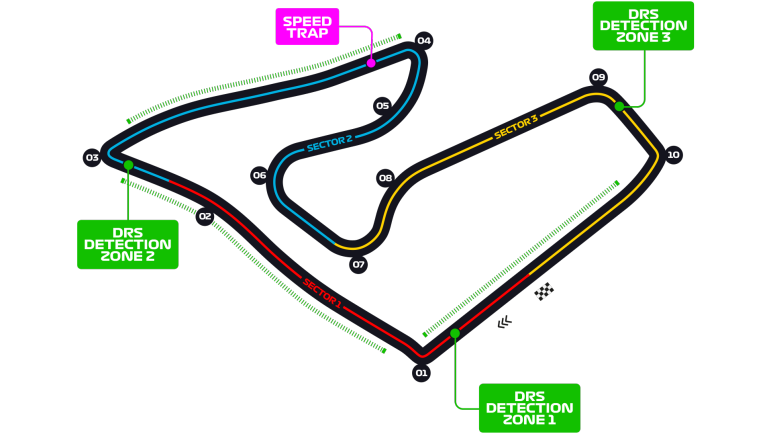
Austrian GP, held in the Red Bull Ring is the home race of the sister teams of Red Bull and Toro Rosso. The Red Bull Ring by itself is an interesting circuit. It seems simple on paper, but it has a myriad of elevation changes. Situated in the Alps, the race track tests the drivers braking skills to the limit. Turns 1 and 3 are uphill, giving the drivers a chance to brake late into the corner giving them a chance to overtake. These turns are usually a sight of plenty of overtaking and controversial collisions. Hamilton infamously collided with then rival and teammate Nico Rosberg going into turn 3 in 2016 which cost Rosberg a race win. Turn 3 was also the location of a textbook overtake by Sebastian Vettel on Lewis Hamiltion last year in 2018.
Turn 4 is slow sloping right hander which is at the end of DRS zone, presenting an overtaking opportunity for only the bravest drivers. Turn 4 can be used to spring surprise maneuvers round the outside of the driver. The circuit has 3 DRS zones to assist overtaking. With the larger rear wings and DRS flaps, there should be a lot of action especially in the mid field.

Above: Lewis Hamilton and Nico Rosberg collide in 2016 costing Rosberg a win
Below: Sebastian Vettel sqeezes his Ferrari past Hamilton in a textbook overtake
The Red Bull ring is the quickest circuit in the calendar in terms of lap times. The pole lap last year was round about 1:03 s (AMAZING!). It is also one of the most power sensitive circuits owing to it’s 3 DRS zones and elevation changes. Teams will be looking to get the power balance right along with the balance of the car. The cars will look to be more rear stable to prevent understeer and sliding. The circuit has gravel traps laid out really close in sector 2. Especially near turns 4, 5, 6. These are locations of potential hazards. Small driver mistakes can cause heavy consequences and even retirements.

 Everything Formula One